Categories
TOURS TO RWANDA TOURS TO UGANDA

The Ultimate Guide to Gorilla Tracking in Uganda

The Ultimate Guide to Gorilla Tracking in Uganda

Gorilla tracking is one of the world’s top wildlife experiences and the one we receive the most enquiries about:  Am  fit enough to track gorillas? What is the best time of year to track gorillas? How do I obtain gorilla tracking permits? In this blog post we provide the answers to these questions and more to enable you to book your gorilla experience with confidence, as part of your wildlife safari.

Let’s Talk Gorilla Tracking

Mountain gorillas are among the biggest of the great apes. They share 98% of our DNA, making it uncanny when you see some of their features and behaviours; they’re just like us – only hairier!

They exist only in the mountainous forests of the Virunga Volcanoes, straddling Uganda, Rwanda and DR Congo and in Bwindi Impenetrable forest, in Uganda.

As an endangered species, there are just over 1,000 remaining, but recent conservation efforts have been successful, and numbers are slowly increasing. Unlike lowland gorillas, mountain gorillas do not survive in captivity, so you can only see them in the wild.

In this blog, we explain how we can help you do that.

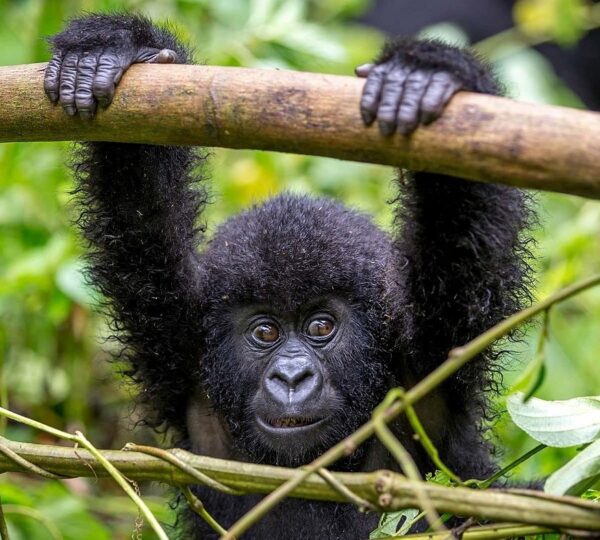
Young Gorilla

A Very Special Wildlife Experience

Your super exciting tracking day looks something like this:

You’ll start at around 07:30am with a briefing at the park/sector HQ. Afterwards, you’ll be allocated to a group to track a specific gorilla family and begin by heading to where that family was last seen the day before.

Your group will have up to 8 trackers, a park ranger, any porters that members have hired and possibly any other researcher or vet that may want to visit that gorilla family. The rangers will be armed in case they need to scare off any wildlife. They also carry radios for communication.

As you walk through the rain forest, tracking the gorillas, look out for mammals, tropical birds, and some fascinating vegetation. Your ranger will be happy to tell you all about them, the local community and the Batwa tribe that used to live in the forest.

When you find your gorilla family, you will spend one magical hour with them. You may find a Silverback eating, a female grooming or infants playing. Perhaps the whole family will be moving or even fighting. Your ranger will be on hand to keep you safe, get you the best views and let you know when photography is allowed. What a privilege to be allowed into the gorillas’ world and observe their natural behaviour in their natural habitat.

Trackers usually bring a packed lunch and there will be time to eat this and learn more about the gorillas from your ranger on your way back. What cherished memories you will have of this exciting yet humbling experience.

Should you wish to spend more time with the gorillas, there is a habituation experience lasting around four hours where you enter the forest with rangers who are habituating gorillas (getting them to accept a human presence). Many people, especially photographers, also opt to track twice as each day is different and so is each gorilla family, but there is a 90%+ chance that you will see the gorillas when you are tracking, so you do not need to track twice.

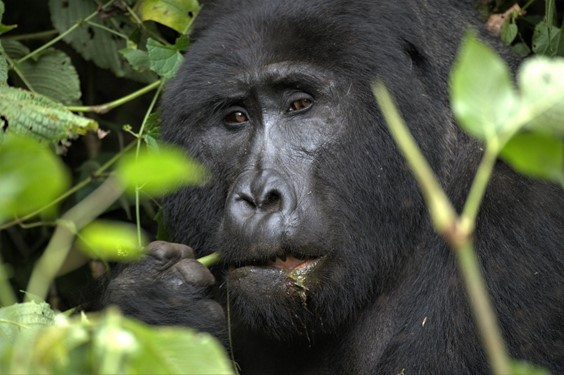
Gorilla

Obtaining Tracking Permits

About half of the world’s gorillas live in Uganda, so, naturally, we think Uganda is the best location to track gorillas. 😊

To track mountain gorillas in the wild, you need a permit from the local authorities. Tracking is difficult in DR Congo because of the security situation. The cost of a permit in Rwanda is USD 1,500pp, but in Uganda it is USD 800pp.

You can track gorillas in two parks in Uganda. Mgahinga Gorilla National Park has 1 habituated gorilla family and Bwindi Impenetrable National Park has 4 different forest sectors and 21 habituated gorilla families. We can recommend the location that best suits clients’ itineraries and needs.

In Uganda, permits can only be bought through a licensed Ugandan tour operator, so, as such, Venture Uganda is able to secure gorilla tracking permits for our clients. These must be paid for, in full, in advance and are non-refundable. There is a charge to reschedule them.

Young Gorilla's playing

Am I Fit Enough to Track Gorillas?

The answer is probably yes. Only a normal level of fitness is required. Although, in parts, the terrain can be steep and slippery with thick vegetation, you can move at your own pace.

There is no pressure to go fast or keep up, and you can rest whenever you need to. Rangers are on hand to help you and we recommend hiring local porters to carry bags and physically support you in moments where you need a hand (or shove!). It’s all very good humoured.

We have a few tricks up our sleeves, too. We can select the most appropriate forest sector for you when buying permits and, on the day, we can request that anyone with difficulties/injuries is allocated to the group tracking the nearest family. There is even a service where you can be carried by porters in a special chair for all, or part, of the trek.

The trek takes anywhere from 2-8 hours but, in our experience, 3-5 is more normal. Some even find their family within one hour! But be careful what you wish for; many people like to think they have put in a bit of effort to earn the reward of spending an hour with these gentle giants.

Gorilla in Uganda seen on a safari with Venture Uganda

When Is the Best Time to Track Gorillas?

Gorilla tracking in Uganda is a year-round activity but it may be slightly less wet and slippery in the rainforest during the dry seasons – approximately March – May and June – September.

Tracking Gorillas

What Should You Wear to Track Gorillas?

There are footpaths in the forest, big and small, but you are also likely to have to head into thick vegetation to reach your gorilla family. Footwear is important in a wet, slippery, muddy rainforest, so a pair of walking boots or good trainers is essential.

You’ll also need long trousers tucked into socks to prevent scratches from vegetation and to stop creepy-crawlies heading where you don’t want them!

A long-sleeved shirt can also protect your arms from scratches. Dark, natural colours are best. Some people wear gaiters, others a little cotton neck scarf.

A rain jacket with a hood is useful, just in case it rains, but rain jackets can be hired from the Park HQ on the day. You will also be offered the loan of a walking stick. Don’t forget your camera or phone with enough storage space and possibly a spare battery. Oh, and you might want to bring insect repellent too.


Can I add gorilla tracking onto my holiday to Africa?

The answer is, yes, you can and we are happy to design a programme that works for you.


How do I get to the Gorillas?

Gorilla experiences are usually part of a wildlife safari to Uganda but we can also add them as an extension to a holiday elsewhere.

The journey from Entebbe to South western Uganda, where the gorillas live, takes about 9 hours, by road. A road trip can often be such fun as you drive through the villages and countryside of rural Uganda, cross the equator and gain an insight into daily life. However, we prefer to break the road journey with a stopover at the fabulous Lake Mburo national park where you can take a game drive, safari walk, mountain bike or horseback safari to look for mammals like giraffe, impala, eland, leopard, buffalo and more. There is also a boat cruise on the lake which is particularly good for birders.

You’ll need to spend a night near Bwindi or Mgahinga national parks so you can join the daily briefing at 07:30 before tracking. Your track could take between 3-6 hours, on average, so you’ll need another overnight stay before returning to Entebbe the next day. You could possibly stop again at Lake Mburo but this time to enjoy some great community activities like visiting the Ankole long-horn cows of the Bahima people.

Depending on your international flight connections, you may need another night in Entebbe. There is plenty to do in this quiet town including visiting the island chimpanzee sanctuary, botanical gardens on the shores of Lake Victoria or taking a sunset boat cruise to the equator line.

We are happy to use our expert knowledge of the country to design a wonderful gorilla tracking break for you. A rare and special wildlife experience.

Alpha male Gorilla

There are some important rules to follow when gorilla tracking:

  • Photography is allowed and your ranger will tell you when it is appropriate. However, to minimise disturbance to the gorillas, flash photography is not allowed.
  • Remain with the group. Be patient and do not hog the best views.
  • If a gorilla charges, crouch down, and avoid eye contact. Do not try to run away.
  • Keep voices low when near gorillas.
  • Maintain a distance of 7 metres from the gorillas.
  • If you need to go to the loo in the forest, dig a hole and bury it.
  • Do not leave any rubbish in the forest.

Otherwise, follow your ranger’s instructions at all times.

Gorilla Conservation

How Can I Support Gorilla Conservation?

Simply by tracking, you are providing income to the Uganda Wildlife Authority which looks after the gorillas. Their work includes providing veterinary services, deploying rangers to protect the gorillas, conducting monitoring and research activities, and delivering community conservation education.

  • Support community members who, in turn, value and protect the gorillas.
  • Stay in community-owned lodges, hire porters to carry your bags and help you while on the trek.
  • Book your holiday with a company that uses local guides for activities like birding or community nature walks.
  • Buy some local coffee to take home. The proceeds support gorilla conservation, local NGOs/charities and community groups.
  • Spread the love. Tell friends and family all about your experience tracking mountain gorillas. Encourage them to visit Uganda and track gorillas or to support gorilla conservation charities.
  • Do not go gorilla tracking if you are ill. Even the flu or a cold can be transmitted to the gorillas and could be fatal. All trackers may be required to wear a face mask.

And let’s hope you don’t pay for a permit only to have the gorillas show up in your hotel garden!

Watch this amazing video of mountain gorillas touching a human!
Categories
TOURS TO RWANDA

Making the Most of Akagera National Park, Rwanda

Making the Most of Akagera National Park, Rwanda

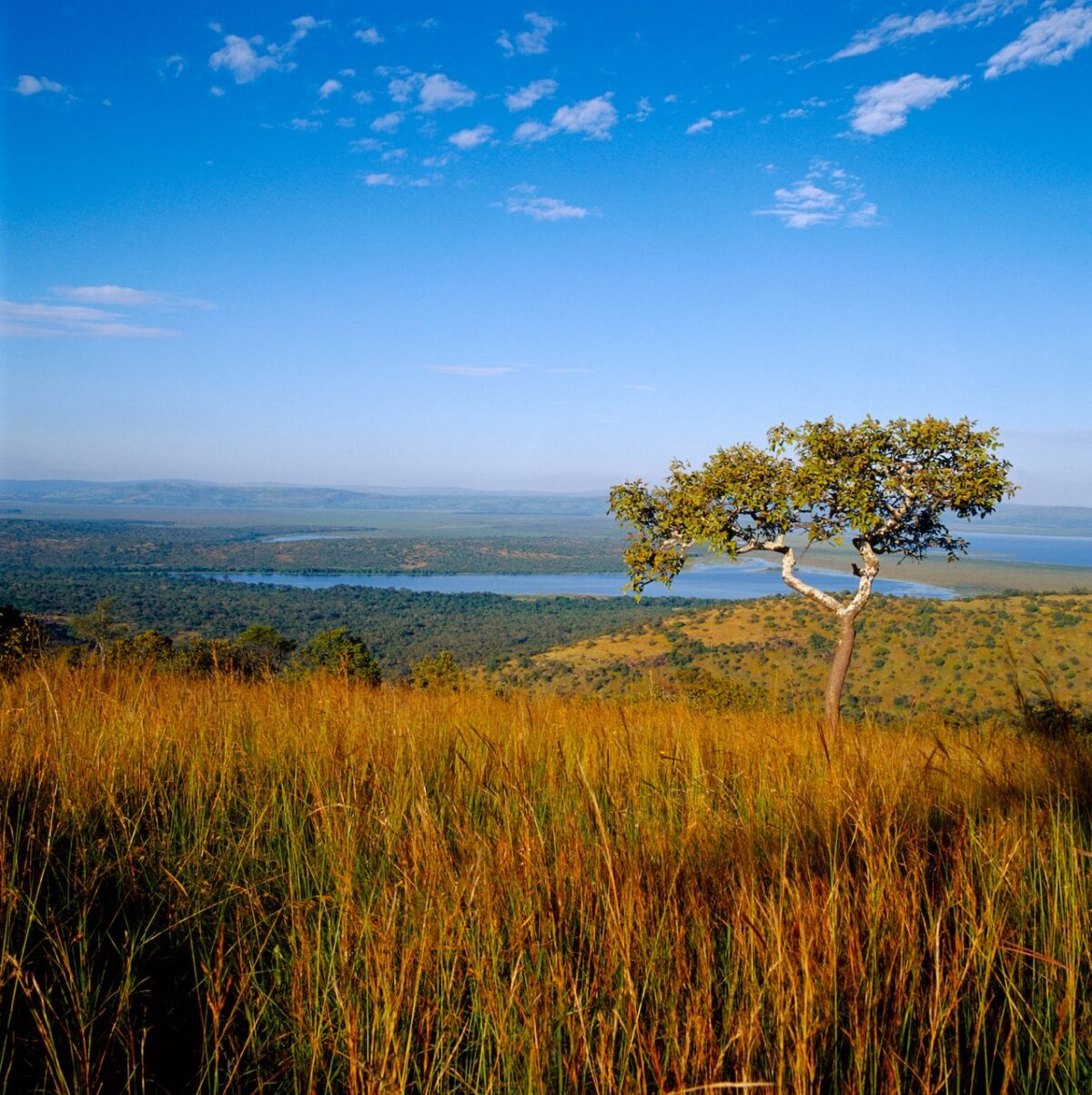
In Rwanda’s Eastern Province, a 3-hour drive from the capital, Kigali, you will find Akagera National Park. This beautiful park is one of the oldest on the African continent and the biggest in Rwanda, making it home to a wide variety of wildlife species.

With its stunning scenery and rich wildlife, it’s easy to see why Akagera welcomed 56,219 guests last year!

Akagera boasts 10 picturesque lakes, including Lake Ihema, the largest lake in the park, where you can take a boat cruise and admire the wildlife from the water, an unforgettable experience.

To reduce the human-wildlife conflict and ensure harmony with the surrounding communities, the park is fully enclosed by an electric fence. This important conservation measure protects both the park’s wildlife and the people who live nearby.

We highly recommend visiting Akagera for at least a couple of days as each day in the park is different; there are so many areas and activities to explore! Our knowledge of Akagera means we can create fantastic itineraries that allow you to make the most of this spectacular park.

Black and White Rhinos

Black and White Rhinos

Black and white rhinos can be found in Akagera National Park in Rwanda – and no, we don’t mean zebra-like hybrids!

Both black and white rhino are highly endangered, but are flourishing at Akagera thanks to the Park’s conservation measures. For example, in 2024, as part of an important capacity building exercise with local vets from The Rwanda Wildlife Conservation Association, the Akagera team fitted transmitters into seven white rhinos and three black rhinos. Just one measure to keep them safe.

The proof of the pudding is in the eating and the Akagera team were delighted when last year four black rhinos and three white rhinos were successfully born, clearly demonstrating the effectiveness of their conservation work.

Look out for rhino as part of your game drive in the Park. White rhinos are often found wandering in small groups and are more amiable and tolerate tourist viewings, even when they have their calves. Black rhinos, however, tend to be more solitary and aggressive, and will often hide away in the bush.

Much of the Park’s income comes from tourism so every visit made has a positive impact on the wildlife, environment and community which really shows what responsible tourism can achieve!

Animals of Akagera

Animals of Akagera

It’s not just rhinos you’ll find in Akagera; there are plenty of other majestic animals to discover, too – over 8,000 species!

As Central Africa’s largest protected wetland, with highlands, lakes, and vast plains, Akagera has a thriving population of wildlife.

The park is now home to the Big 5 – lion, leopard, elephant, buffalo and rhino. But here you will also find giraffes, hippos, zebras, crocodiles, antelopes, elands, impalas, warthog and baboons and numerous monkey species.

The park values responsible tourism and has worked hard on conservation initiatives and re-introduction of species which went extinct after Rwanda’s genocide.

Cruise the Shorelines of Akagera

Cruise the Shorelines of Akagera

Taking a boat cruise on Akagera is both an exhilarating and relaxing experience. First, you’ll enjoy the thrill of speeding across the lake, soaking up the wonderful scenery, feeling the fresh air on your face.

Then, you will begin to slow down and gently meander along the shoreline as you relax and look for animals who make their way to the water’s edge to cool off or quench their thirst. Keep your eyes peeled for buffaloes, antelopes and elephants.

Let us know if you’d like to include a scenic boat ride on your itinerary and spot beautiful wildlife from the water.

Go Behind The Scenes

Go Behind The Scenes

Ever wondered what it’s like to protect wildlife? Then why not experience conservation and go behind the scenes of Akagera?

You can join the staff at the park and learn about the amazing conservation work they do, gain insight into the park strategies and hear about all the success stories and the challenges.

Then, visit the Control Room where you can learn how technology is deployed to increase the effectiveness of staff conservation work and research, such as monitoring animal behaviour and movements.

You can also visit the stores which are filled with the equipment confiscated from poachers, before going to the K9 unit where staff train dogs to help in the fight against poaching.

If you’re interested in any of these activities going behind-the-scenes, please get in touch and we can add that to your adventure.

Stay at Akagera Game Lodge

Stay at Akagera Game Lodge

Wondering where to stay when you visit Akagera?

One of the accommodations we recommend is the wonderful Akagera Game Lodge, a stunning hotel overlooking superb views of Lake Ihema. Ideally located near the south gate and park reception, this medium-sized resort makes a great base to explore Akagera’s offerings.

The hotel provides lovely comfortable rooms, some with balconies and lake views, and the food is delicious, with extensive buffets offering a great choice of quality local and international dishes. You might even get a chance to see the chef preparing some to order as you watch!

You’ll also find recreational facilities available like the lovely swimming pool. Or why not play a game of tennis on the court? The friendly, helpful staff are on hand to make you feel right at home.

Get in touch if you’d like to stay here.

Rwanda's Birding Paradise

Rwanda’s Birding Paradise

Akagera is a fantastic bird-watching location thanks to its abundant bird life.

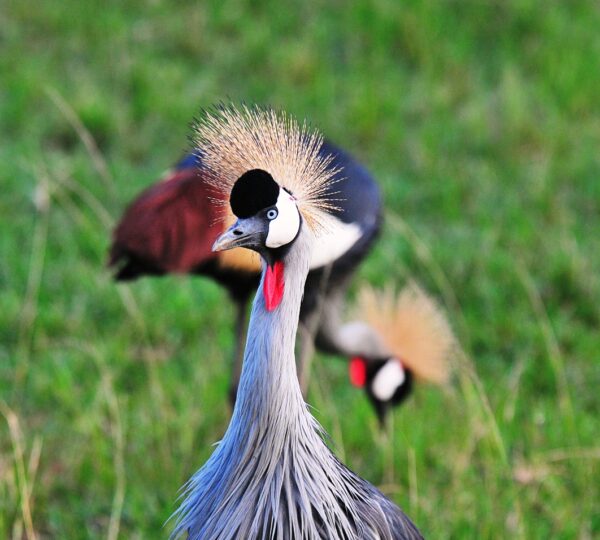
The vast range of habitats from woodland to wetland and savannah to open water, means the park is thriving with over 550 bird species, like the magnificent Grey-crowned crane or the African Fish Eagle. The knowledgeable site guides know the best places to spot particular species and love sharing their insight into these beautiful birds.

You can even enjoy watching the colony of weaver birds right outside the lodge’s main entrance, or the Lesser Blue-eared Starlings and other cheeky birds that like to steal crumbs from the dining table!

Explore the Community Centre

Explore the Community Centre

If you’d like to spend time in the community, then there’s plenty to do just outside the park at Akagera Community Centre. The Centre is well-worth adding to your itinerary because it is the hub of many community activities and is funded by the Park, showing how your visit (and payment) can directly help the local community.

The centre provides food to the park and nearby hotels. It also runs community farming schemes (like poultry farming) and has a library and resource centre to support local schools. Residential educational visits are also hosted here for students to learn more about the community and conservation.

Discover Rwanda’s rich heritage at the small museum and visit the charming craft shop selling handmade crafts. You can even arrange to see traditional dancing by the local community group.

The Akagera Community Centre is a meaningful way to gain deeper insight into Rwanda and connect with the people. Let us know if you’d like more details.

We'll Help You Discover the Magic of Rwanda

We’ll Help You Discover the Magic of Rwanda

The park continues to serve as a learning hub, hosting various institutions who seek insight from its conservation success model.

Our love and knowledge of the park means we can help you discover the magic of Rwanda. Even better, for many nationalities, visas are not required to visit.

So, whether you’re looking to include the park in a Rwanda-only adventure or combine it with a trip to Uganda, the Venture Uganda team is on hand to help you every step of the way.

Categories
TOURS TO RWANDA TOURS TO UGANDA

Uganda & Rwanda: Welcoming Visitors From Around the World

Uganda & Rwanda: Welcoming Visitors From Around the World

This year we have attended several consumer and travel trade events, in different countries, promoting our destinations and services. We’ve reconnected with old friends, strengthened partnerships, and created new alliances. And we’ve met some lovely people with a genuine interest in wildlife, culture and outdoor activities – adventurers who wish to explore, learn and enjoy new places.

As we continue to welcome clients from around the world – from Australia to Belgium and USA to Spain – we thought this month we would share some helpful information about working with us and travelling to Uganda and Rwanda, no matter which country you’re visiting from!

Language Is Not a Barrier

Thank you, Google Translate!

The friendly staff in our Kampala office speak English and a range of different local languages. Most colleagues from around the world communicate with us in English but some simply write to us in their own language; we use the power of Google Translate and then we respond in our own language. You’d be surprised by how well this works!

We also have apps and foreign-language-speaking guides and friends on ‘speed dial’ and a range of other tools to help, if needed.

So, if you’ve hesitated to contact us because you’re worried about a language barrier, then now you know there’s nothing to worry about! With flexibility and a bit of good humour, we work very well with partners worldwide.

Foreign Language Speaking Guides

Did you know English is the most commonly spoken language in Uganda?

In 2005, Swahili became an official language, but it’s not as widely spoken as in other East African countries. Uganda is also home to many tribal languages.

In Rwanda, the national language is Kinyarwanda, which is spoken throughout most of the country. French is also an official language; however, since the 90s English has gradually become more popular.

We’re proud to say that we have a wide range of professional safari guides who speak a second language, including French, Spanish, Chinese and Russian, to name just a few! These guides will happily escort you on your holiday, sharing their knowledge of the country in your language and translating where necessary. They might even teach you a few words of their language too!

Which Airlines Fly Into Entebbe and Kigali?

So, how are you going to get here?

There are plenty of airlines that fly into Entebbe (Uganda) and Kigali (Rwanda). These include:

Rwandair
Uganda Airline
KLM
Air France
Brussels Airlines
Emirates
Qatar Airways
Ethiopian Airlines
Turkish Airlines
Kenya Airways

Tailor-made Travel

There are lots of statistics published about national travel habits which identify some trends and common behaviours for each country. But we treat every client as an individual because we know every trip is unique – each holiday is personal. That’s why we offer a fully bespoke service, handling all kinds of requests.

Whether someone is celebrating a special occasion, has a specific interest or wants to book last minute, we can design a custom holiday.

Others may prefer a slower pace, want to travel alone or don’t speak English – we can factor this into a personal itinerary.

Why not book a call with us to have a chat? Then you can leave the rest to us!